Religion as an Interface of Knowledge
What if religions were never explanations of the world, but interfaces for interacting with it?

We tend to read ancient religious systems through a modern lens: as attempts to explain what people could not yet understand scientifically. Thunder was Thor. Disease was divine punishment. The movement of stars was the will of gods. As science advanced, religion retreated — or so the standard story goes.
But this reading may be getting the direction of causality backwards. It assumes that religion was always trying to do what science does, only less effectively. What if it was trying to do something else entirely?
The Structure of Ritual
Look closely at the structural properties of early religious systems across cultures and you find something unexpected: they behave less like explanatory narratives and more like execution protocols.
The defining features are consistent:
- Strict procedural accuracy — rituals must be performed in precise sequence, with exact words, gestures, and materials. Deviation is not merely incorrect; it is dangerous.
- Repetition without variation — the same actions are repeated across generations with explicit resistance to modification. The point is not novelty but fidelity.
- Resistance to reinterpretation — the meaning of a ritual may be debated endlessly, but the form is conserved. Priests argue about what the sacrifice means; no one argues about whether to perform it differently.
This is not the structure of a story. It is the structure of a program.
A narrative can be retold with variations and still transmit its content. A procedure cannot. Change the order of steps in a chemical synthesis and you get a different compound — or an explosion. Change the sequence of a ritual and, within the logic of the system, you get a corrupted output.
The question is: output of what?
Interfaces, Not Explanations
The word interface is useful here. An interface is a layer that allows two systems to interact without either needing to fully understand the other. A touchscreen is an interface between a human nervous system and a computational architecture. The human does not need to understand transistors; the computer does not need to understand human intention. The interface translates between them.
What if ritual functioned as an interface of this kind — a structured procedure for interacting with some aspect of reality that the practitioners could use without fully understanding the underlying mechanism?
This reframes several features of religious practice that are otherwise puzzling:
Prayer as a protocol, not a petition. The structure of prayer in many traditions is not a simple request. It involves precise address (the correct name or attribute of the recipient), specific framing (the relationship of the petitioner to the recipient), and often a procedural structure (confession, thanksgiving, petition, closing). This is not how you ask a favor from a friend. It is how you make a correctly formed function call.
Sacred text as specification, not metaphor. The insistence in many traditions that sacred texts must be preserved exactly — not just in content but in precise wording, often in languages no longer spoken — makes no sense if the texts are primarily vehicles of meaning. It makes complete sense if they are specifications whose exact form matters for their function.
Taboo as access control. The elaborate restrictions around who can perform which rituals, in which states of purity, at which times — these look like arbitrary social hierarchy when read as moral rules. They look like access control layers when read as operational constraints.
Cross-Cultural Invariants
If ritual is primarily symbolic, we would expect its forms to vary widely across cultures, reflecting different symbolic systems and social structures. And indeed, the content of ritual varies enormously — the gods named, the animals sacrificed, the words spoken.
But the structure shows surprising invariance.
Anthropologists have documented that ritual systems across widely separated cultures share deep formal properties: the use of threshold crossing (entering and exiting sacred space), the suspension of ordinary time, the requirement for specific personnel in specific states, the irreversibility of certain acts, and the emphasis on exact repetition. These structural commonalities appear in traditions with no historical contact — not because humans naturally think the same way, but possibly because the underlying operational requirements are the same.
This is what we would expect if different traditions were independently developing interfaces to interact with the same underlying reality, rather than independently inventing symbolic systems to represent their different understandings of it.
The Degradation Signal
One of the most consistent features of religious history is what happens when ritual forms are altered: practitioners report that the practice stops working. Not that it becomes less meaningful — that it becomes less effective.
This is usually read as superstition or as the psychological effect of reduced confidence in the ritual. But it is also what we would predict if the forms carried operational weight. Change the parameters of a process and the output changes. Change them enough and you get no output at all.
The history of religious reform is full of cases where modifications intended to make practice more rational or accessible resulted in traditions that felt — to their practitioners — emptied of something. The reformers preserved the meaning and altered the form. The practitioners, following their operational intuitions, knew that something had been lost even if they could not say what.
What Was Lost With the Frame
The deeper implication concerns not any specific religious tradition but the category of knowledge that ritual may have been transmitting.
Homo sapiens has a strong tendency to replace procedure with narrative. We are story-making animals. When we encounter a practice we do not understand, we construct an explanation for it — and once the explanation exists, the practice is gradually reshaped to fit the explanation rather than the other way around.
This process, repeated across centuries and cultures, would systematically degrade operational knowledge while preserving narrative knowledge. The stories would survive; the procedures would drift. And the knowledge encoded in the procedures — whatever it was, whatever it was interfacing with — would become inaccessible not because it was destroyed but because the interface was corrupted through well-intentioned reinterpretation.
We may have inherited the shell of something we no longer know how to run.
The Open Question
This framework does not tell us what the interface was interfacing with. That remains genuinely open. The possibilities range from the mundane (ritual as a sophisticated technology for managing collective attention and social coordination, whose effects are real but entirely psychological) to the more speculative (ritual as a method for interacting with aspects of reality that our current scientific frameworks do not adequately describe).
What it does suggest is that the standard dismissal of ritual as primitive explanation is probably wrong in an interesting direction. The people who designed these systems — or who inherited and preserved them with such extraordinary fidelity — were not confused about the nature of the world. They were operating with a different model of what could be accessed and how.
The form was the function. We preserved the form. We may have forgotten the function.
This article is part of the Protocol series — methods and frameworks for thinking at the edge of what the archaeological record can tell us.
Editorial Archive
Related articles
The Belt That Remembered
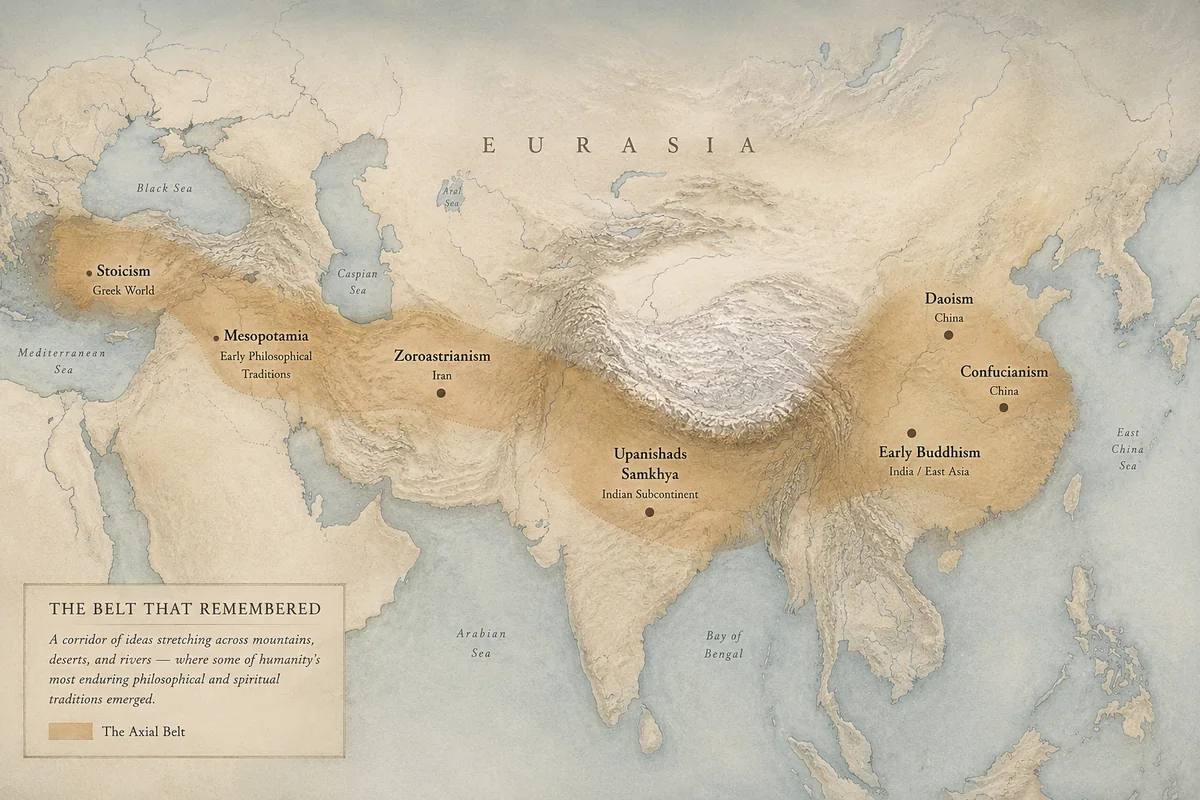
Long before ideas could travel quickly, remarkably similar ways of understanding reality appeared across the same broad belt of Eurasia. Coincidence is one explanation. It may not be the only one.
The Contingent Machine
Modern physics didn't emerge from pure curiosity. It emerged from war, industry, and the need to move things faster. That origin shapes everything we can — and cannot — ask.

Permissible Questions
Science has never developed in an ethical vacuum. What if the questions a civilization is permitted to ask determine the physics it eventually discovers?

Alternative
What if the most advanced civilization in Earth's history left almost nothing behind — not because it failed, but because it succeeded?