The Belt That Remembered
Long before ideas could travel quickly, remarkably similar ways of understanding reality appeared across the same broad belt of Eurasia. Coincidence is one explanation. It may not be the only one.
I. The Observation
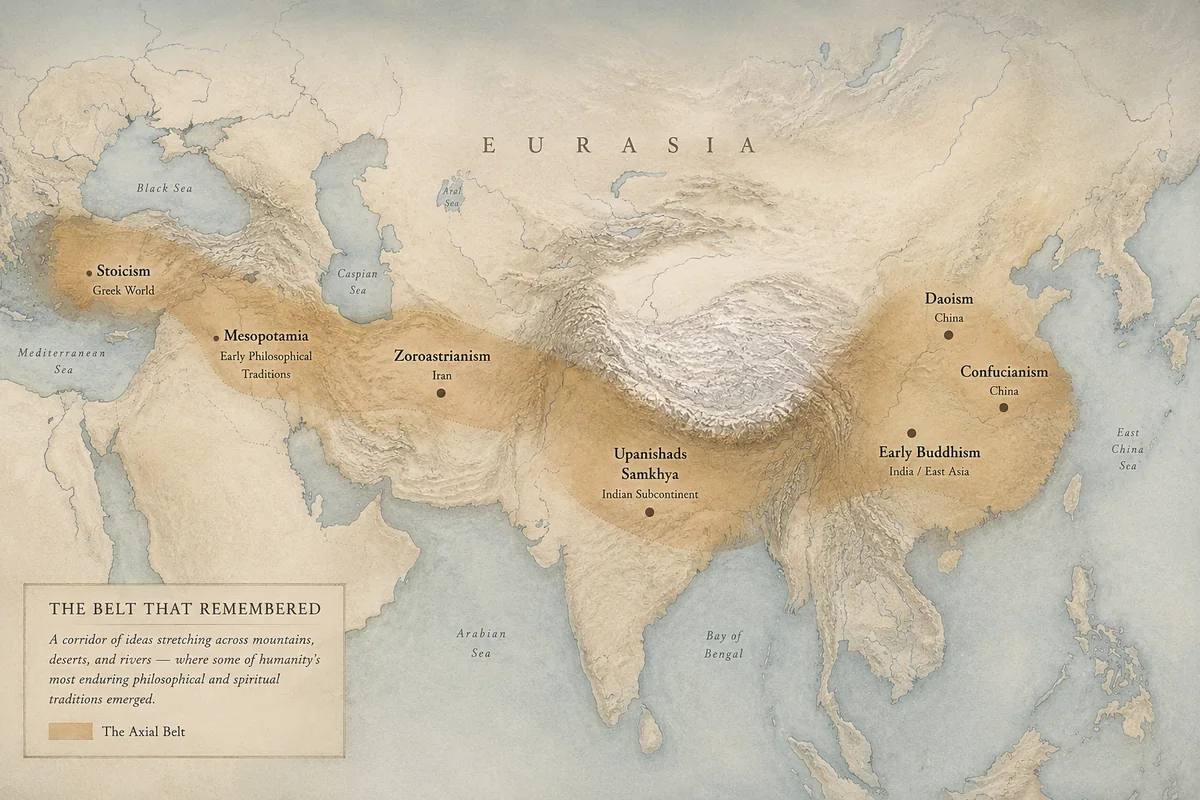
Draw a line across a map.
Begin at the eastern Mediterranean. Cross Mesopotamia and the Iranian plateau. Continue through the Indian subcontinent. End in China.
Now mark where some of the world's most influential philosophical and religious traditions emerged.
Stoicism occupies the western edge. Early Zoroastrianism appears in Iran. The Upanishads and Samkhya develop on the subcontinent. Daoism, Confucianism, and early Buddhism cluster farther east.
These traditions differ profoundly in language, ritual, political setting, and theological vocabulary.
Yet many of them arrive at strikingly similar orientations toward reality: an emphasis on process over static being, recurring rather than purely linear time, and knowledge understood less as domination than as alignment.
That observation is relatively uncontroversial.
The harder question is what, if anything, such a pattern allows us to infer.
II. The Method
When similar intellectual structures appear across widely separated societies, several explanations are possible.
They may have developed independently in response to similar human problems. They may reflect cultural transmission across long networks of contact. Or they may preserve fragments of an older tradition whose original form has disappeared.
None of these explanations can be assumed in advance.
The task is not to choose the most dramatic hypothesis, but to ask which one best accounts for the evidence available.
Historians and archaeologists already apply this reasoning to technologies, myths, artistic motifs, and ritual practices. Philosophical traditions deserve the same caution.
The remarkable feature of this belt is not that its traditions resemble one another in detail.
It is that they repeatedly return to comparable questions about time, order, knowledge, and humanity's place within the world.
III. What the Source Might Have Been
Suppose, only as a working hypothesis, that these similarities preserve more than coincidence.
The common source need not have been an empire, nor a single religion carried intact across continents.
It may instead have been something far less centralized: a body of practices, metaphors, and habits of thought transmitted over very long periods, adapting continuously as it entered new languages and cultures.
Such traditions leave remarkably little archaeological evidence.
They survive not because texts endure, but because ways of thinking become embedded in ritual, education, and ordinary practice.
If fragments of such a tradition persisted, what they would share would not necessarily be doctrines.
They would share orientations.
Reality understood as process rather than finished object.
Balance preferred to domination.
Knowledge valued as calibration before control.
These are not technologies.
They are assumptions about what knowledge is for.
IV. Why This Belt Endured
If such an orientation once extended more broadly than its surviving traces suggest, another question becomes more interesting.
Why did it persist here?
Part of the answer may lie in ecology.
The Mediterranean, the Iranian plateau, the river systems of India, and eastern Asia each rewarded long-term observation of recurring environmental cycles. Seasonal rhythms, rivers, monsoons, and agricultural continuity naturally encouraged ways of thinking centered on recurrence, balance, and adaptation.
Migration mattered as well.
Ideas travel with people, but they also change as communities divide, settle, and reconnect. Long continuity can preserve an intellectual tradition even as its outward forms become almost unrecognizable.
Finally, catastrophe acts as a filter.
Institutions collapse. Languages disappear. Archives are destroyed.
What often survives is not a complete intellectual system but only those fragments resilient enough to be absorbed into whatever culture follows. Traditions rarely survive intact; more often, they persist as orientations whose original context has already vanished.
The absences deserve as much attention as the presences.
Some regions experienced repeated disruptions in cultural continuity. Others developed largely outside this corridor. Whether similar traditions once existed there is difficult to know. What survives is not necessarily what once existed most widely, but what remained continuously transmissible.
Seen from this perspective, the remarkable feature is not that these traditions differ.
It is that, despite centuries of separation and repeated historical disruption, recognizable patterns continue to appear across the same broad geographic corridor.
V. What We Are Actually Looking At
This is not an argument for a forgotten empire.
Nor is it evidence for a single civilization stretching across Eurasia.
It is a more modest observation.
Some of humanity's most influential traditions appear within the same broad geographic belt, and many of them return to remarkably similar questions about reality, knowledge, time, and order.
The pattern deserves explanation.
Why do some of humanity's most enduring traditions keep returning to such similar ways of describing reality?
Whether the similarities reflect convergence, transmission, or inheritance from a deeper intellectual tradition remains an open question.
This article is part of the Protocol series — methods and frameworks for thinking at the edge of what the archaeological record can tell us.
Editorial Archive

Related articles
The Contingent Machine
Modern physics didn't emerge from pure curiosity. It emerged from war, industry, and the need to move things faster. That origin shapes everything we can — and cannot — ask.

Permissible Questions
Science has never developed in an ethical vacuum. What if the questions a civilization is permitted to ask determine the physics it eventually discovers?

Alternative
What if the most advanced civilization in Earth's history left almost nothing behind — not because it failed, but because it succeeded?

The Thin Layer of Civilization
How we measure the past may be telling us more about ourselves than about what was there.