Permissible Questions
Science has never developed in an ethical vacuum. What if the questions a civilization is permitted to ask determine the physics it eventually discovers?

The Sacred Architecture of Knowledge
It is tempting to imagine science as a universal process that any sufficiently intelligent civilization would eventually discover in roughly the same form.
Observe. Measure. Test. Refine.
From this perspective, our physics appears inevitable — not one path among many, but the path itself. A patient enough civilization, we assume, would eventually arrive at the same particles, the same forces, the same mathematical descriptions of reality.
But this assumption hides a deeper question.
Before a civilization can answer questions about reality, it must decide which questions are worth asking in the first place.
And that decision is never scientific.
It is cultural.
The Invisible Assumptions Behind Discovery
Scientific inquiry does not emerge in a vacuum.
Every civilization inherits assumptions about time, causation, order, meaning, and humanity's relationship to the world. Most of these assumptions are not experienced as beliefs. They are experienced as reality itself.
The history of science provides countless examples.
The belief that nature is governed by consistent laws. The assumption that the future can differ from the past. The idea that knowledge can accumulate across generations. The conviction that observation is preferable to authority.
These seem self-evident to us.
Yet each is, in part, a cultural inheritance before it becomes a scientific principle.
What a civilization considers meaningful determines what it chooses to investigate. What it considers sacred determines what it hesitates to touch. What it considers impossible determines which questions never become experiments.
Science does not merely discover reality.
It discovers reality through a framework of prior assumptions about what reality is.
What Ethics Allows
A cosmology does more than explain the universe.
It establishes boundaries.
Some questions become important. Others become irrelevant. A few become unthinkable.
If the world is understood as a mechanism, then disassembling it becomes a legitimate path to knowledge.
If the world is understood as a living process, the same act may carry ethical consequences.
If time is linear, progress becomes a coherent objective. Each intervention moves history forward.
If time is cyclical, equilibrium becomes more important than transformation. Actions are judged less by what they achieve than by what they disrupt.
These are not merely philosophical preferences.
Over centuries, they influence which disciplines receive attention, which technologies are pursued, and which forms of knowledge acquire prestige.
The direction of science is not determined only by evidence.
It is also shaped by what a civilization believes knowledge is for.
A Different Relationship to Knowledge
Imagine a civilization organized around a fundamentally different sacred architecture.
Not less rational.
Not less curious.
Simply oriented toward different questions.
Perhaps reality is understood primarily as process rather than object. Stability is valued more highly than expansion. Continuity is admired more than novelty. Long-term equilibrium carries greater ethical significance than short-term achievement.
Such a civilization would still observe the stars, study living systems, develop mathematics, and refine models of the world.
But its intellectual energy might flow toward different problems.
Not how to accelerate change.
But how to sustain complexity.
Not how to maximize extraction.
But how to minimize irreversible damage.
Not how to control systems.
But how to understand the conditions under which systems remain stable.
The result would not be less science.
It would be differently directed science.
Why It Vanishes
If a civilization shaped by such principles eventually collapsed, the most important part of its knowledge might disappear first.
Physical structures can survive collapse in fragments.
Ethics cannot.
A wall can endure for centuries.
A tool can survive in the ground for millennia.
A worldview survives only while it is actively transmitted.
Once the institutions that maintain it disappear — teachers, rituals, stories, social expectations, systems of meaning — the logic that held the civilization together begins to dissolve.
The visible forms may remain.
The invisible framework vanishes.
What survives are symbols without explanations. Rituals without context. Myths whose original function is forgotten.
Later observers encounter these fragments and classify them as folklore, superstition, or primitive belief.
Yet what they may be seeing is the residue of an intellectual system whose foundations have already disappeared.
The Archaeology of Assumptions
When archaeologists recover the material remains of a civilization, they recover its tools far more easily than its questions.
A foundation reveals engineering.
A weapon reveals metallurgy.
A monument reveals organization.
None of these necessarily reveal what a civilization believed knowledge was for.
This creates an asymmetry in the archaeological record.
We are skilled at recognizing technologies.
We are far less skilled at recognizing the ethical and cosmological frameworks that directed them.
The result is a persistent temptation to interpret past societies as earlier versions of ourselves — pursuing the same goals, asking the same questions, merely possessing fewer capabilities.
That assumption may be wrong.
Some civilizations may have been organized around entirely different intellectual priorities.
If so, much of what appears to us as absence may simply be misinterpretation.
The Synthesis
Science does not emerge independently of culture.
Every system of knowledge develops within a structure of values, assumptions, and permissible questions.
A different sacred architecture would not produce less understanding of reality.
It would produce a different map of reality.
And if such a civilization were lost, the map itself would disappear long before its surviving symbols.
The challenge is not merely recovering what earlier civilizations knew.
It is recovering the assumptions that made their knowledge possible.
We may not be looking at the unfinished beginnings of our own science.
We may be looking at the surviving fragments of questions we no longer know how to ask.
This article is part of the Protocol series — methods and frameworks for thinking at the edge of what the archaeological record can tell us.
Editorial Archive
Related articles
The Belt That Remembered
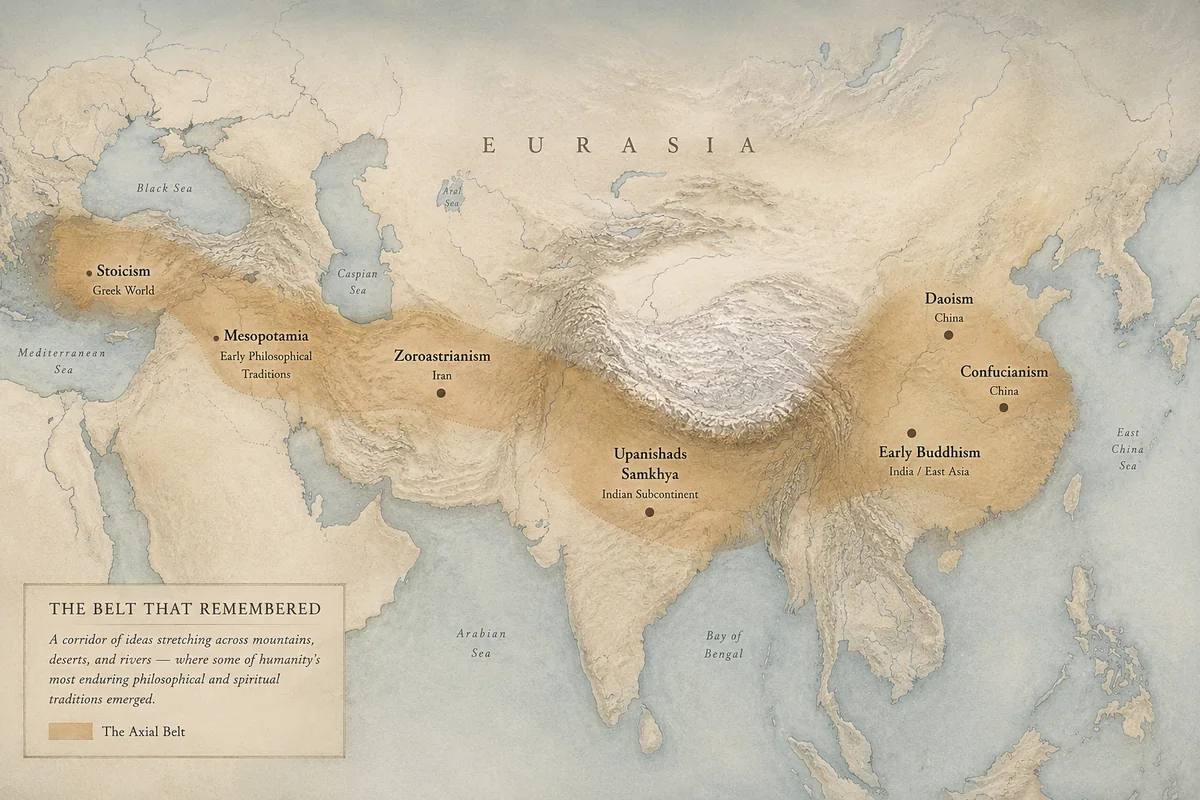
Long before ideas could travel quickly, remarkably similar ways of understanding reality appeared across the same broad belt of Eurasia. Coincidence is one explanation. It may not be the only one.
The Contingent Machine
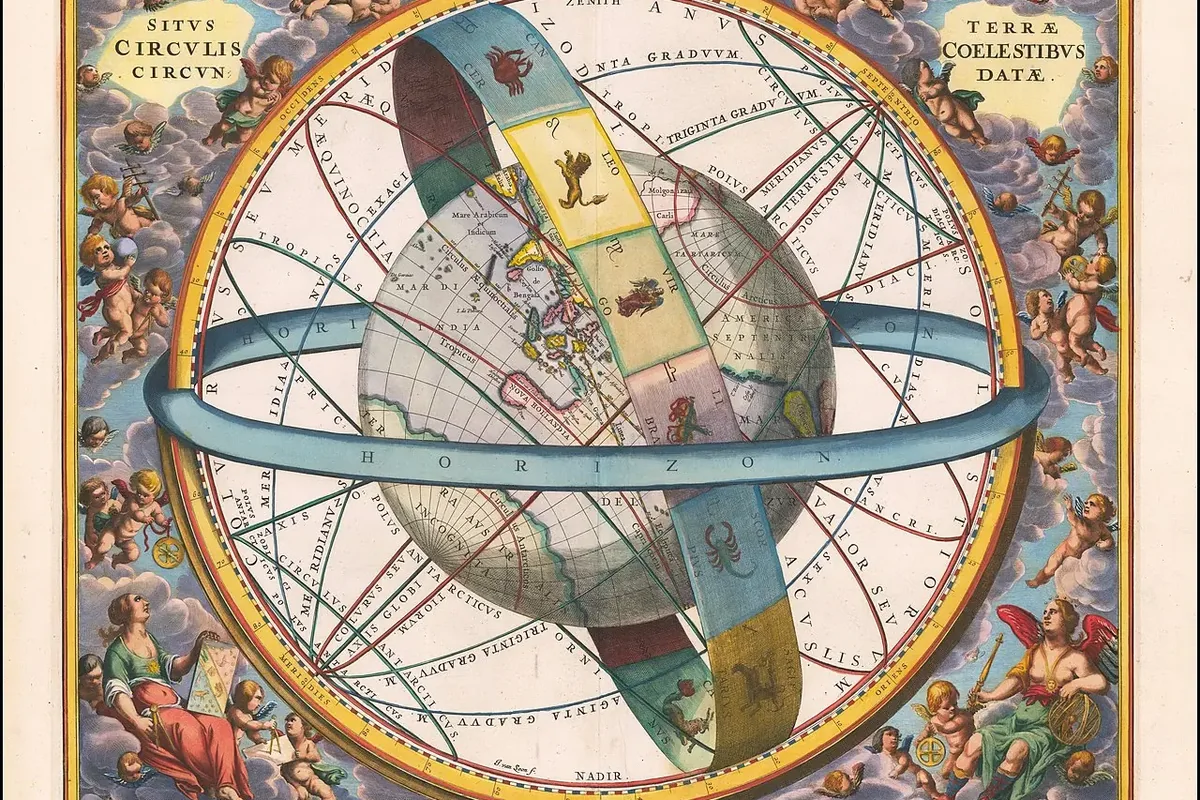
Modern physics didn't emerge from pure curiosity. It emerged from war, industry, and the need to move things faster. That origin shapes everything we can — and cannot — ask.

Alternative
What if the most advanced civilization in Earth's history left almost nothing behind — not because it failed, but because it succeeded?

The Thin Layer of Civilization
How we measure the past may be telling us more about ourselves than about what was there.