
Alternative
What if the most advanced civilization in Earth's history left almost nothing behind — not because it failed, but because it succeeded?

The standard model of civilizational progress is essentially a story of accumulation and expansion. More energy, more territory, more complexity, more control. Every major civilization we know — Mesopotamia, Rome, the industrial West — followed some version of this trajectory. We tend to assume this is not just what civilizations do, but what they must do to reach high levels of development.
This assumption may be wrong. Not as a utopian wish, but as a straightforward consequence of thinking carefully about what "advanced" actually means.
A Different Goal Function
Our civilization emerged from a specific set of pressures: resource scarcity, territorial competition, the constant threat of violence from neighboring groups. Under these conditions, the logic of expansion is rational. Grow or be absorbed. Accumulate or be outcompeted. The civilizations that survived were the ones that optimized for power.
But this is not the only possible starting condition.
A civilization that developed under different constraints — lower population density, richer ecosystems, fewer competing groups, or simply a longer period of stability before the first major resource crisis — might have optimized for something else entirely. Not power, but reliability. Not growth, but continuity. Not the maximum output of a system, but its minimum failure rate.
The difference is not moral. It is engineering. A civilization that asks "how do we build systems that last?" arrives at very different answers than one that asks "how do we build systems that win?" The first question leads toward closed material cycles, distributed networks, deep ecological knowledge, and social structures designed for long-term stability. The second leads toward hierarchy, specialization, resource extraction, and the concentration of power.
Both are rational. Only one leaves a large archaeological footprint.
High Development Without Industrialization
We associate technological sophistication with industrial output: machines, mass production, megacities, the visible transformation of landscapes. But this association reflects our own developmental path, not a necessary feature of advanced knowledge.
Consider what deep expertise actually looks like when the goal is not production but stability:
Ecological knowledge at the level of a civilization that has observed the same landscapes for tens of thousands of years would be qualitatively different from anything we possess. Not just knowledge about ecosystems, but embedded, procedural knowledge of how to live within them without degrading them — the kind of knowledge that leaves no material trace because it was never externalized into artifacts.
Medical knowledge oriented toward prevention and systemic health rather than acute intervention would not produce hospitals or pharmaceutical factories. It would produce practices, diets, social structures, and environmental management strategies that simply kept populations healthy — and would be nearly invisible to archaeology.
Astronomical knowledge accumulated over geological timescales would not require radio telescopes. It would require generations of careful observers and a social structure capable of transmitting precise observations across millennia. The knowledge itself might be encoded in myth, ritual, or architectural alignment — in forms that our frameworks interpret as religious rather than scientific.
Energy systems at small scale but high reliability — using water, wind, thermal gradients, or biological processes — would leave no equivalent of our power plants, pipelines, or transmission lines. They would be integrated into the landscape in ways that are difficult to distinguish from natural features.
None of this is science fiction. Each of these represents a direction in which existing human knowledge could have developed, under different historical pressures, over a much longer timeframe.
War as a Social Technology, Not a Biological Necessity
One of the most persistent assumptions in discussions of human prehistory is that warfare is essentially universal — a feature of human nature that any civilization must contend with and that inevitably shapes its development.
The archaeological and anthropological evidence for this view is weaker than is commonly assumed. Warfare as an organized institution — with dedicated warriors, command structures, and systematic violence between groups — appears relatively late in the human record, and correlates strongly with specific social conditions: high population density, resource concentration, territorial pressure, and the emergence of hierarchical societies with something worth defending and something worth taking.
A civilization that maintained low and stable population density, distributed rather than concentrated resources, and non-hierarchical social structures would not necessarily develop warfare as an institution. Not because its members were morally superior, but because the structural conditions that generate warfare would be absent.
This matters enormously for the developmental trajectory available to such a civilization. The enormous proportion of human cognitive and material resources that our civilization has devoted to military technology, defensive infrastructure, and the management of security threats would instead be available for other purposes — and over timescales long enough to make the difference between a civilization that developed interstellar ambitions and one that did not.
Space Without Empire
In our imagination, space exploration is usually tied to expansion: new territory, new resources, new frontiers.
But expansion is not the only reason to leave a planet.
A civilization with a sufficiently long planning horizon would eventually recognize that planetary existence is inherently fragile. Asteroid impacts, supervolcanic eruptions, climatic shifts, and stellar evolution operate on timescales that seem distant to individuals but are short in civilizational terms.
For a society oriented toward continuity rather than growth, off-world presence would not be a project of conquest. It would be a form of redundancy.
The path toward it might look very different from our own space programs: less competition, less urgency, and more emphasis on reliability than speed. Not a race to expand, but a slow effort to ensure that a single planetary failure could not erase everything.
The Two-Branch Strategy
If such a civilization ever achieved a permanent off-world presence, it would face an unusual decision.
A society optimized for resilience would be unlikely to concentrate its future in a single location. The same logic that favors redundancy in ecological systems and social structures would apply equally to civilization itself.
Some populations might remain on the home world. Others might establish distant settlements.
Over long periods of time, these branches would diverge.
Knowledge without institutions degrades. Practices survive while explanations disappear. Complex systems become rituals, myths, and fragments whose original purpose is forgotten.
The result would not be a return to primitiveness. It would be the emergence of new societies carrying incomplete memories of older ones.
What We Might Be
The value of this thought experiment does not depend on whether such a civilization ever existed.
Its purpose is to expose an assumption that quietly shapes much of our thinking about the past: that advancement must be visible.
We recognize complexity when it builds monuments, transforms landscapes, concentrates power, and leaves durable artifacts behind.
But a civilization optimized for continuity rather than expansion might do the opposite. It might minimize waste, avoid irreversible environmental change, distribute rather than centralize knowledge, and leave remarkably little material evidence of its existence.
If such a path is possible, archaeology faces an unusual challenge.
The absence of obvious traces may not always indicate the absence of complexity.
The deeper question, then, is not whether a forgotten civilization once ruled the Earth.
It is whether we have mistaken visibility for advancement.
A civilization designed to last might leave almost nothing behind.
Except descendants who no longer recognize what they inherited.
This article is part of the Protocol series — methods and frameworks for thinking at the edge of what the archaeological record can tell us.
Editorial Archive

Related articles
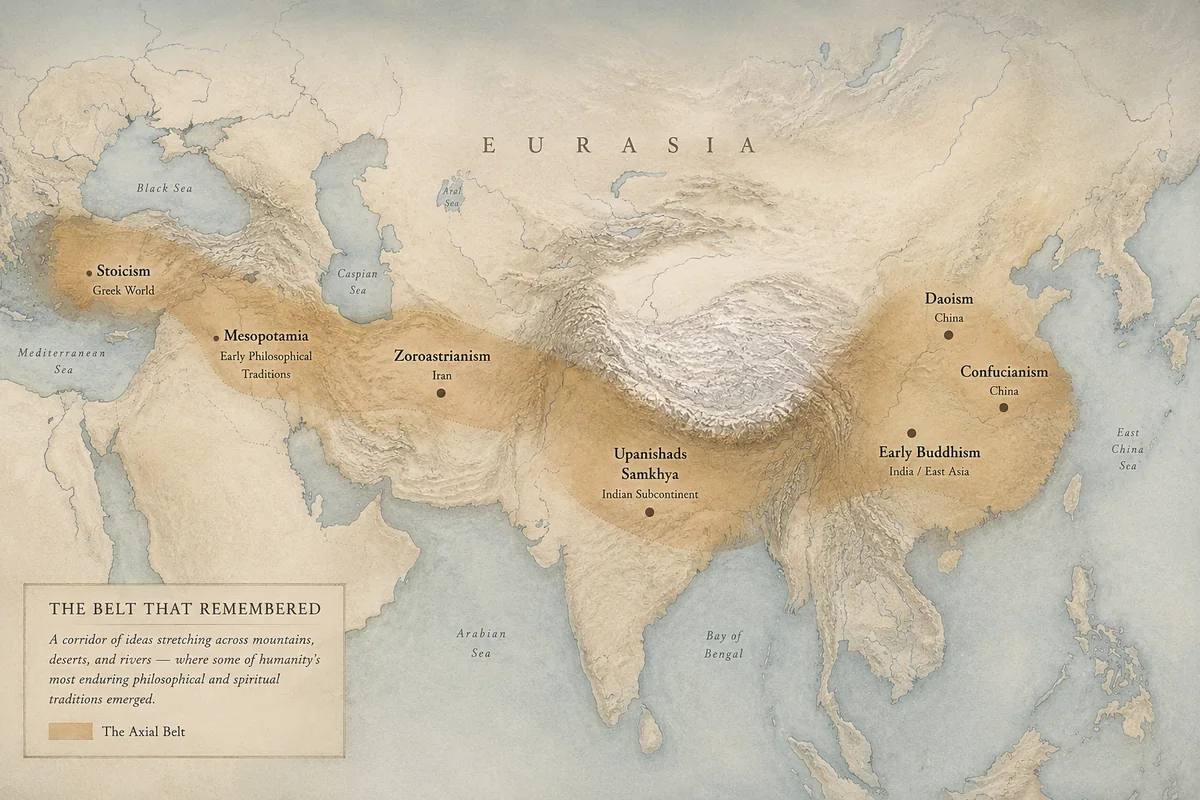
The Belt That Remembered
Long before ideas could travel quickly, remarkably similar ways of understanding reality appeared across the same broad belt of Eurasia. Coincidence is one explanation. It may not be the only one.

The Contingent Machine
Modern physics didn't emerge from pure curiosity. It emerged from war, industry, and the need to move things faster. That origin shapes everything we can — and cannot — ask.
Permissible Questions
Science has never developed in an ethical vacuum. What if the questions a civilization is permitted to ask determine the physics it eventually discovers?

The Thin Layer of Civilization
How we measure the past may be telling us more about ourselves than about what was there.