The Contingent Machine
Modern physics didn't emerge from pure curiosity. It emerged from war, industry, and the need to move things faster. That origin shapes everything we can — and cannot — ask.
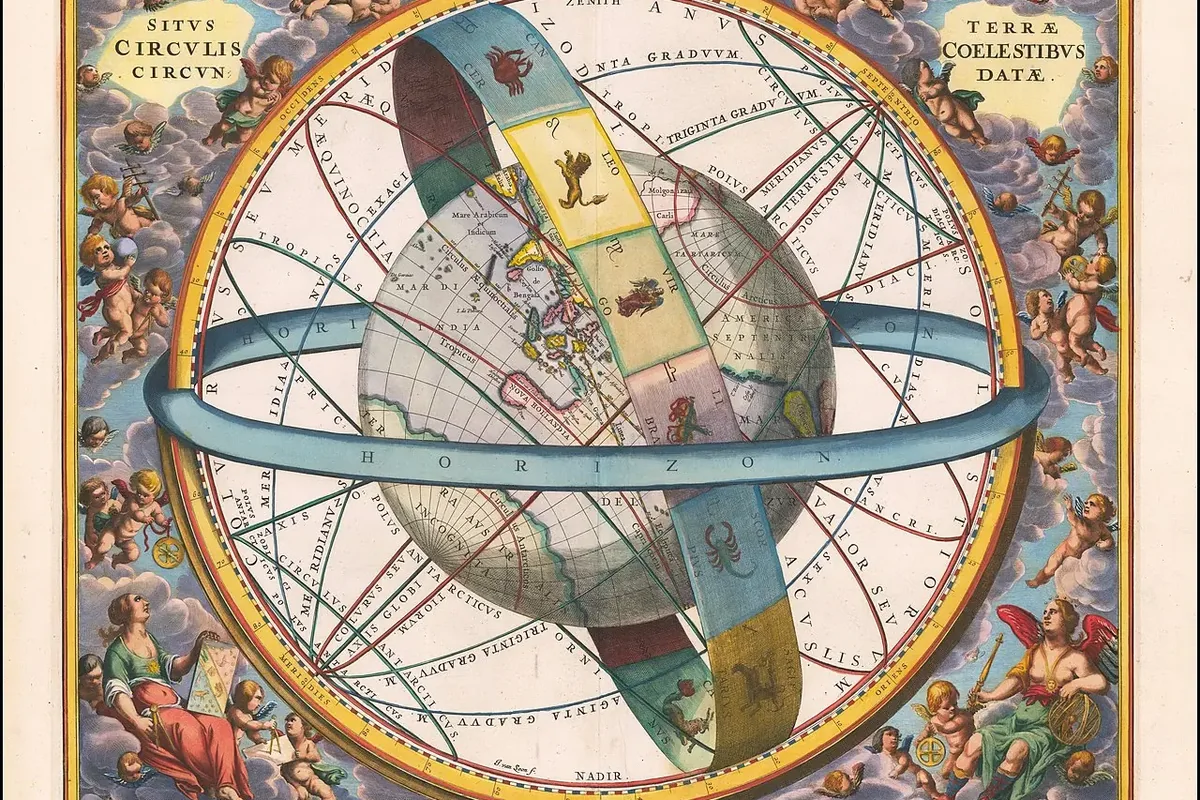
Quantum theory did not arrive as a finished vision of reality. It emerged through a series of repairs. At the turn of the twentieth century, classical physics could not explain why heated objects glow the colors they do. The mathematics produced nonsense at high frequencies — what physicists called the ultraviolet catastrophe. Max Planck introduced a quantization of energy largely to make the equations behave. He later described the move as an act of desperation.
This is how science often moves: not from vision toward theory, but from breakdown toward repair. The repairs accumulate. The scaffolding becomes load-bearing. Eventually nobody remembers it was scaffolding.
The language of classical mechanics — force, mass, trajectory, acceleration — was developed in the seventeenth century to solve specific problems: where a cannonball lands, how a ship navigates, how a lever lifts a stone. Artillery drove the mathematics. Navigation drove the astronomy. The steam engine drove thermodynamics. The telegraph, almost incidentally, clarified the nature of electromagnetism.
Science is not a neutral investigation of nature. It is an investigation shaped by what a civilization needs to do. The questions we know how to ask are downstream of the problems we needed to solve. And many of the problems we needed to solve emerged from warfare, extraction, navigation, and trade.
Imagine a civilization without artillery. Without the pressure of industrialization, without the short economic horizons that demand fast returns on knowledge. A civilization that had thousands of years of stability, a science that was slow, observational, and oriented toward fundamental patterns rather than useful outputs.
The resulting science would not necessarily be incomplete or primitive. It would be directed toward different problems, shaped by different pressures, and organized around different assumptions about what mattered. The same reality might be approached through a different set of questions, producing theories and categories that would feel unfamiliar to us without being any less rigorous.
We have no template for what that looks like. We do not know what questions such a civilization would learn to ask first — or what problems, from our frame, they would find trivial.
Our current physics is not finished. String theory cannot be tested. Quantum mechanics and general relativity remain irreconcilable. The standard model has too many free parameters and no explanation for them. Physicists are open about this — not as a confession of failure, but as a description of where the field is. Paradigm shifts begin exactly here, in the space where the current framework cannot make progress.
The honest position is narrow but firm: we cannot know what a different scientific tradition would have built. We cannot know which assumptions in our current framework are genuinely fundamental and which are products of the path that brought us here. Before Einstein, absolute time was treated as bedrock. That confidence did not survive the twentieth century.
Some bedrock is temporary. We won't know which until it shifts.
This article is part of the Protocol series — methods and frameworks for thinking at the edge of what the archaeological record can tell us.
Editorial Archive
Related articles
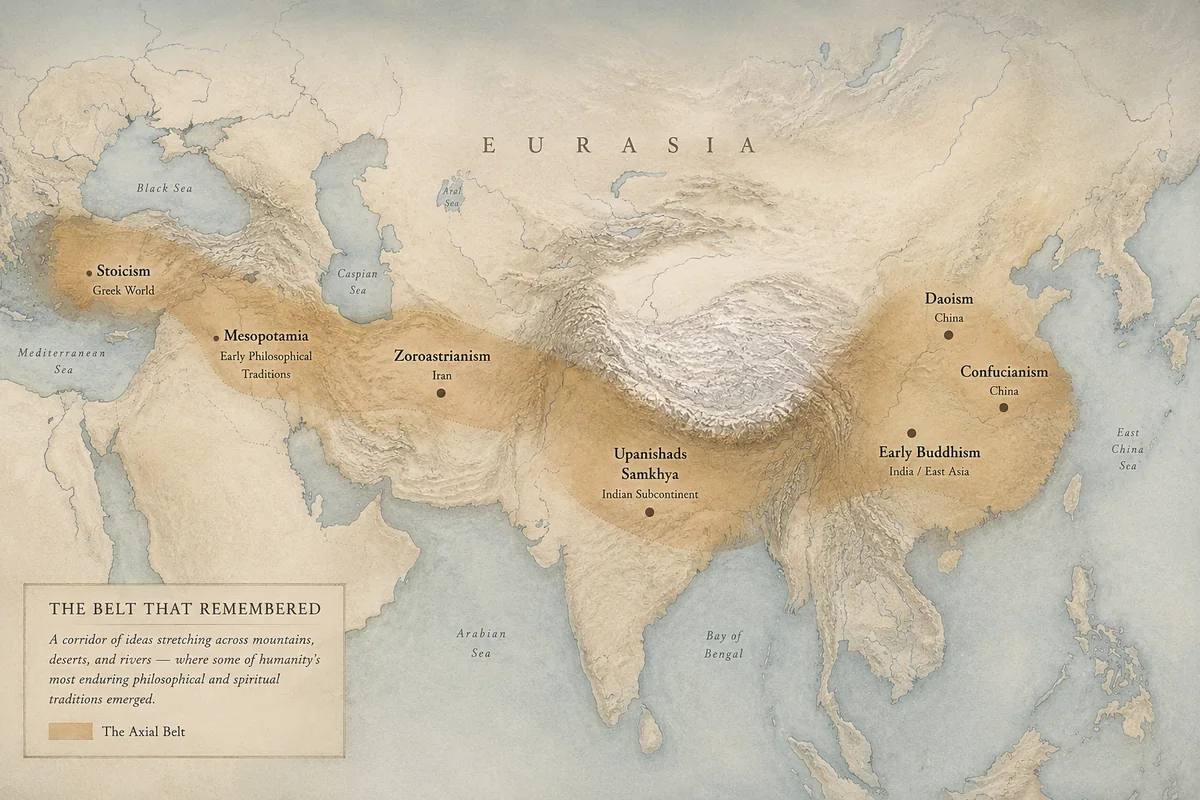
The Belt That Remembered
Long before ideas could travel quickly, remarkably similar ways of understanding reality appeared across the same broad belt of Eurasia. Coincidence is one explanation. It may not be the only one.
Permissible Questions
Science has never developed in an ethical vacuum. What if the questions a civilization is permitted to ask determine the physics it eventually discovers?

Alternative
What if the most advanced civilization in Earth's history left almost nothing behind — not because it failed, but because it succeeded?

The Thin Layer of Civilization
How we measure the past may be telling us more about ourselves than about what was there.