The Layer That Looks Like Us
In 2018, two scientists asked a question that sounds like science fiction and turns out to be rigorous: if an industrial civilization had existed on Earth millions of years before our own, would we be able to tell?

In 2018 two scientists asked a question that sounds like science fiction and turns out to be rigorous. Gavin Schmidt, a climate modeler at NASA, and Adam Frank, an astrophysicist, set it down plainly in the International Journal of Astrobiology: if an industrial civilization had existed on Earth long before our own — not thousands of years ago, but millions — would we be able to tell?
They called it the Silurian hypothesis. The name is borrowed, with a wink, from an old British science-fiction series. The argument underneath it is not a joke.
I.
Begin with the obvious answer and watch it fail.
We would find their cities. Their machines. Their bones.
Except we almost certainly would not.
Fossilization is rare. Exposed sedimentary rock of any given age represents only a fraction of the planet's past surface. Erosion, tectonics, burial, recycling, and time steadily remove the kinds of evidence we instinctively imagine a civilization would leave behind.
Consider how little survives even from our own recent past. The Antikythera mechanism — an extraordinarily sophisticated geared astronomical device built around the second century BCE — survives as an exceptional object with few close parallels in the archaeological record.
Its uniqueness in the surviving record does not tell us how unique such devices were when they were being made.
Push the thought experiment back millions of years and direct evidence — an artifact, a fossilized body — becomes increasingly unreasonable to expect. The older the event, the smaller and less representative the surviving geological sample becomes.
At that scale, looking for objects may be looking for precisely what the Earth is least likely to keep.
II.
So the question changes shape.
Not what did they leave, but what did they leave that lasts.
Not artifacts — chemistry.
A civilization that harnesses energy at a planetary scale rearranges the chemistry of its environment, and some of those changes can persist in sediment long after individual objects have disappeared.
Carbon-isotope shifts associated with burning ancient carbon. Changes to the nitrogen cycle from large-scale fertilizer use. Synthetic compounds with no known natural source. Radioactive signatures from nuclear processes. A thin stratigraphic interval marked by combinations of signals unusual enough to demand explanation.
And the geological record already contains events that share some of these signatures.
The Paleocene–Eocene Thermal Maximum, about fifty-six million years ago, records a major carbon-isotope excursion and rapid global warming over a geologically short interval. Other abrupt events also leave chemical disturbances in sediment.
None of this makes them evidence of industry.
It makes the problem of recognition harder.
At sufficiently coarse temporal resolution, some signatures of a brief industrial episode could overlap with those produced by natural disruptions of the carbon cycle.
Then the mirror turns around.
Our own industrial epoch, read a hundred million years from now, might not announce itself as civilization. It could appear first as a thin and puzzling geochemical anomaly whose cause would have to be reconstructed indirectly.
A brief disturbance.
A layer that seems to mean something before anyone can say what.
III.
Here is the part that matters most, and the part most easily lost.
Schmidt and Frank did not conclude that an earlier industrial civilization existed.
They concluded nearly the opposite: that we could not currently establish such a civilization from the kinds of ambiguous signatures under discussion, and that the question is useful precisely because it exposes what the geological record can and cannot resolve.
They were deliberate about the boundary.
An anomaly nobody can otherwise explain is not evidence of an industrial civilization. The hypothesis does not become likely merely because the record leaves room for it.
They built the fence themselves.
That restraint is not a footnote to the idea.
It is the idea.
The interesting result was never maybe someone was here.
It is that the record has a resolution, and below that resolution entire categories of event become invisible — not absent, invisible.
The distance between absent and invisible is where the real problem begins.
An absence in the record is not an absence in the world. Sometimes it is only the record reaching the edge of what it can hold.
IV.
The paper was written for astrobiology — for thinking about how industrial civilizations might be detected, including beyond Earth.
Its quietest point was also its sharpest: we cannot simply assume that a civilization would leave the kind of evidence we already know how to recognize.
That is where this work begins.
The question opens in three stages, each narrower than the one before.
What kinds of civilization could exist — under conditions unlike ours, using different resources, organizing energy and matter in ways we may not anticipate.
What of them could survive — which traces outlast the systems that produced them, and which disappear with those systems.
And what, of what survives, our methods could actually detect — which signals our instruments and conceptual frameworks are built to recognize, and which would pass through them as noise, ambiguity, or nothing at all.
Most attention goes to the first question because it is the one that fires the imagination.
The last is the one that keeps the rest honest.
A civilization we could describe in perfect detail and still never detect is not, in the end, a story about them.
It is a story about the limits of looking.
This article is part of Protocol — a framework for asking what civilizations could exist, what of them could survive, and what our methods could actually detect.
Editorial Archive

Related articles
What Stone Remembers
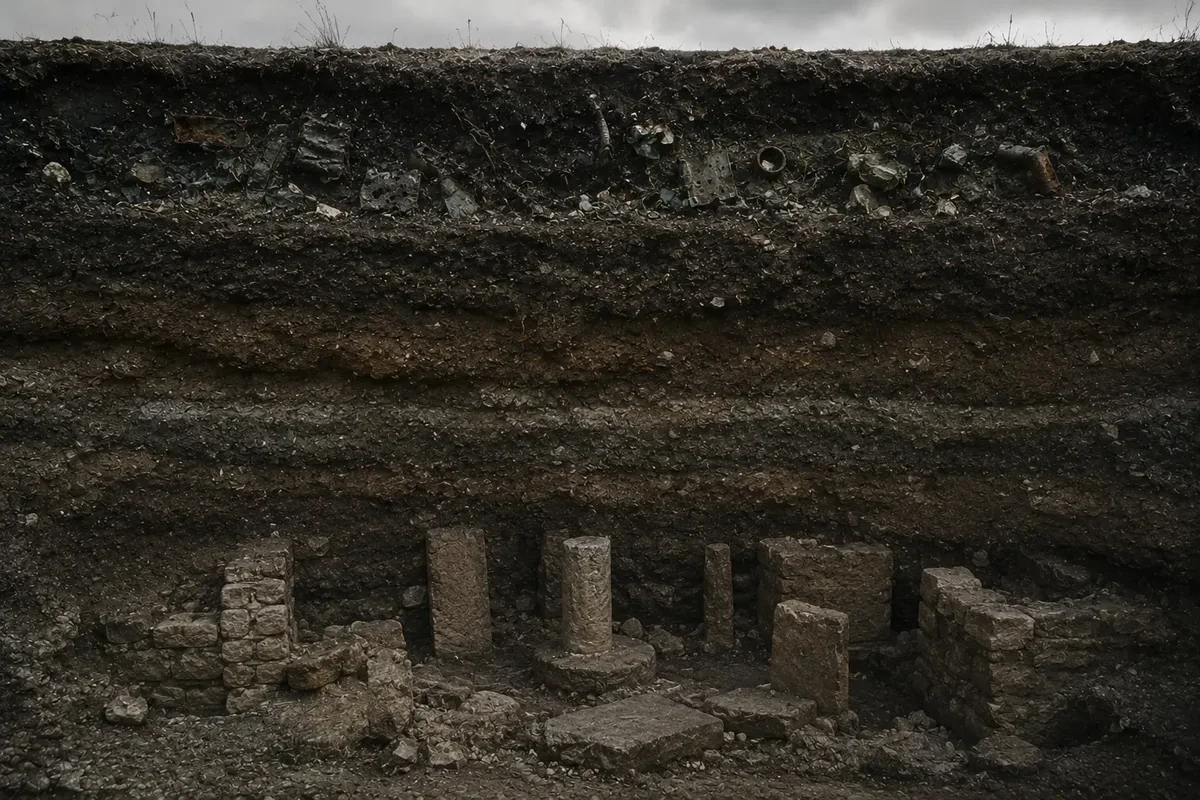
Archaeology does not recover a representative sample of the past. It recovers what time allowed to remain material.
The Belt That Remembered
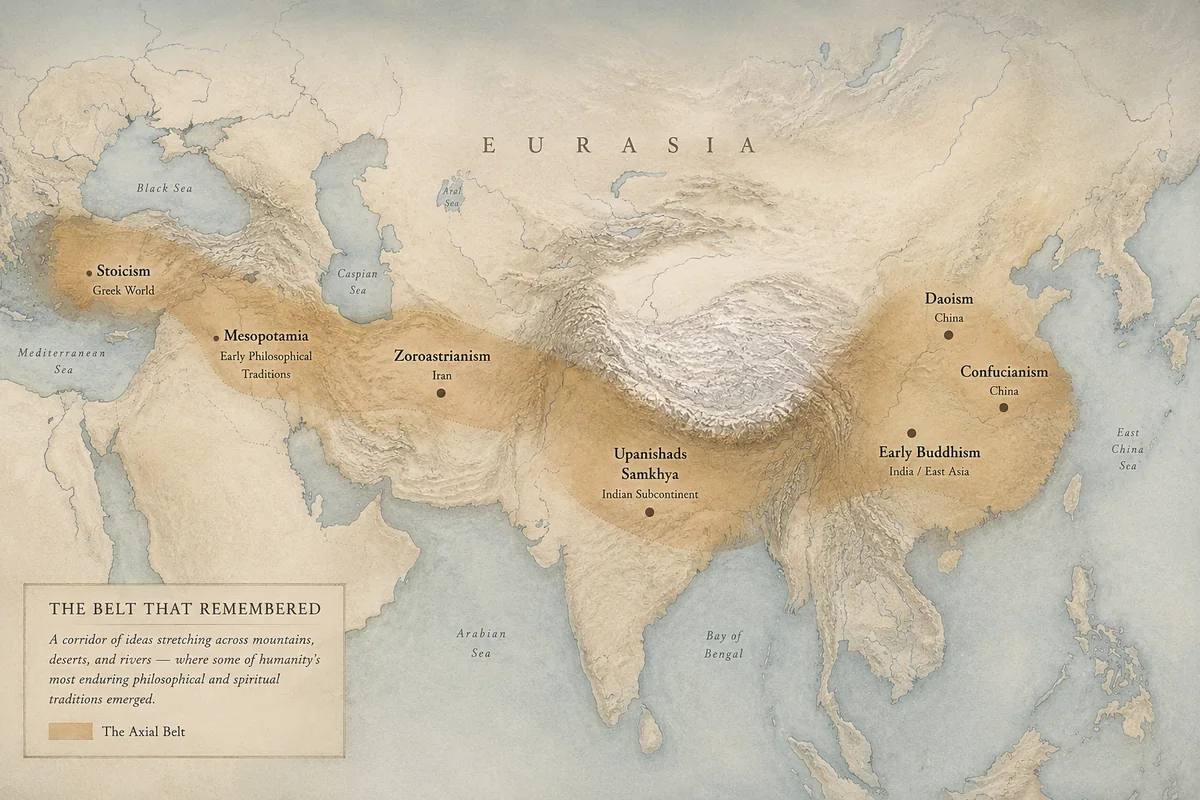
Long before ideas could travel quickly, remarkably similar ways of understanding reality appeared across the same broad belt of Eurasia. Coincidence is one explanation. It may not be the only one.
The Contingent Machine
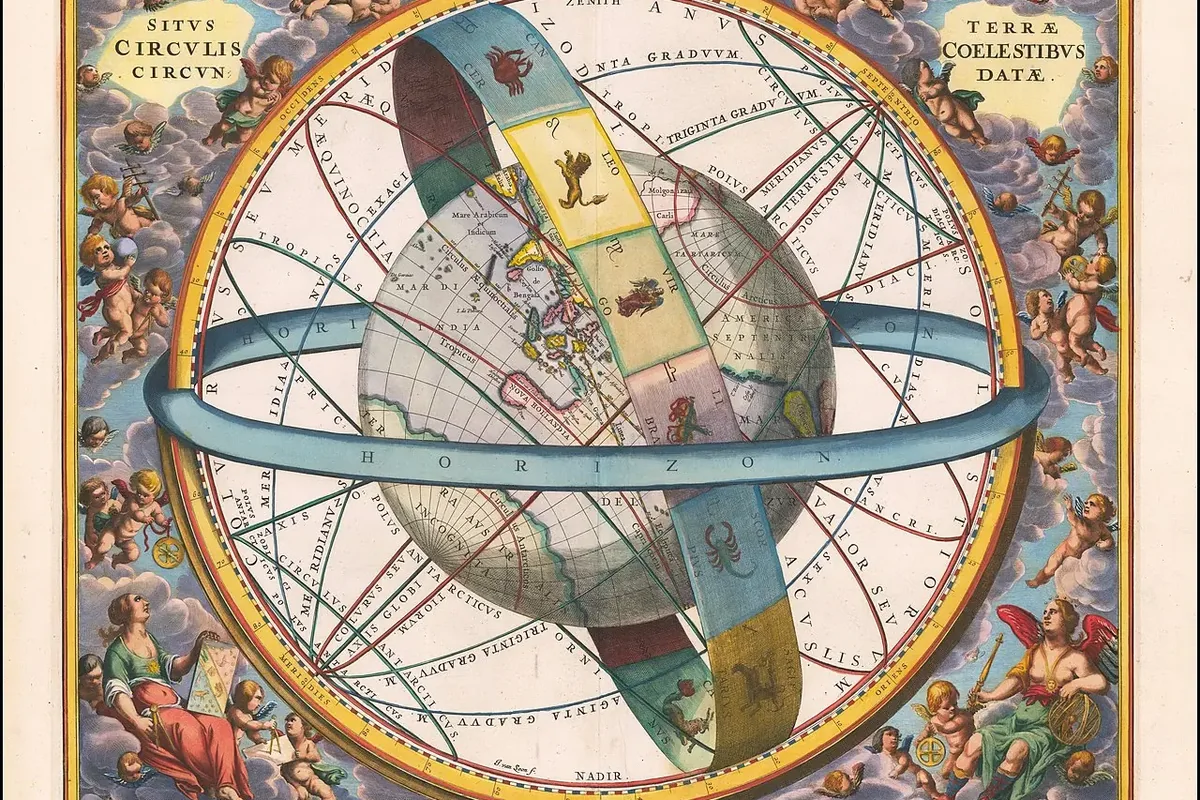
Modern physics didn't emerge from pure curiosity. It emerged from war, industry, and the need to move things faster. That origin shapes everything we can — and cannot — ask.
Permissible Questions
Science has never developed in an ethical vacuum. What if the questions a civilization is permitted to ask determine the physics it eventually discovers?