What Stone Remembers
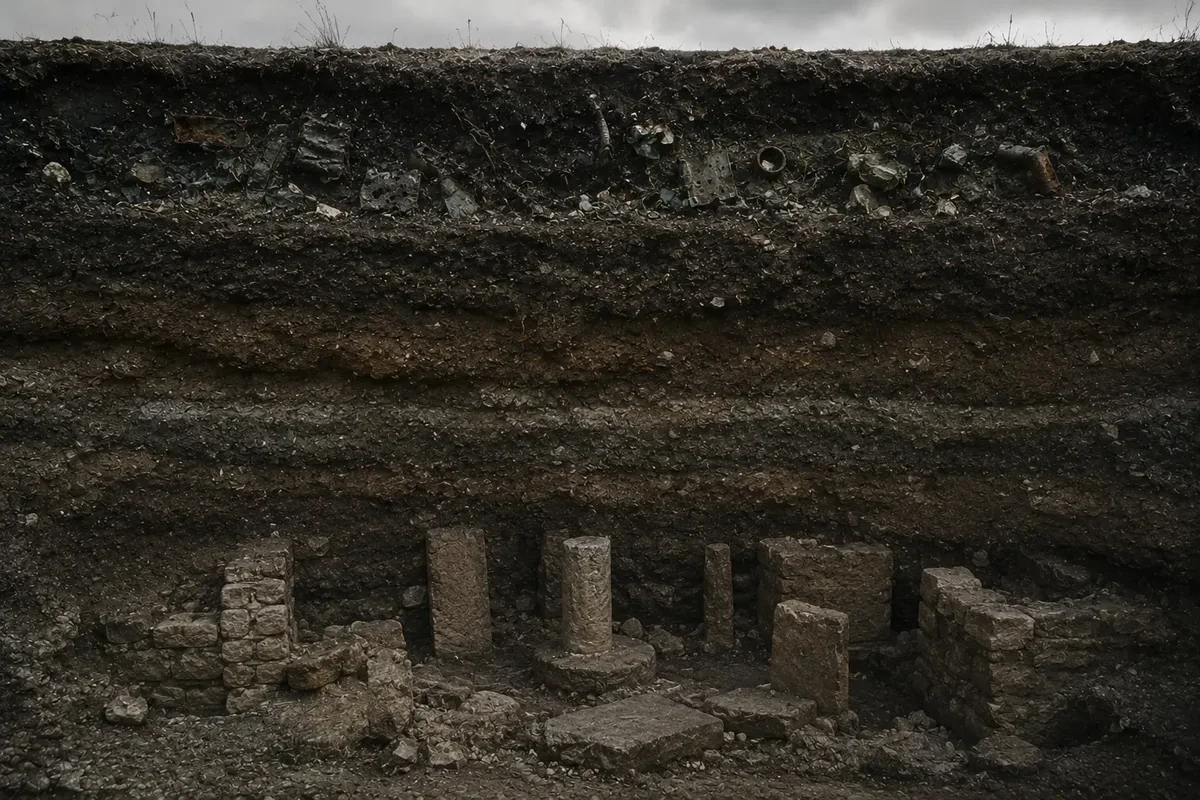
Archaeology does not recover a representative sample of the past. It recovers what time allowed to remain material.
I. The Paradox
Archaeology has an extraordinary record of recovering the past.
It has reconstructed trade networks, diets, migration routes, technologies, and the internal politics of societies that left no written record. The discipline is more rigorous, more self-critical, and more methodologically sophisticated than its popular image suggests.
And yet it confronts a structural problem that no amount of rigor can fully remove.
What survives across millennia is not a representative sample of what once existed. It is a filtered sample, and the filter is not neutral.
Stone survives more readily than wood. Fired clay outlasts woven fibre. Buried foundations remain after roofs, doors, furnishings, and machinery have disappeared. Objects protected in tombs or caves survive better than objects exposed to weather, reuse, and ordinary decay.
Some materials endure because of their physical properties. Others endure because people deliberately made them permanent, maintained them across generations, or placed them in protected contexts.
Across much of recorded history, sacred and funerary structures received precisely this treatment. Temples were rebuilt. Tombs were sealed. Monuments were carved in stone. Ritual objects were deposited rather than discarded.
The result is not an archaeological error. It is a systematic bias built into the material record itself.
Archaeology sees most clearly what time allowed to remain material. In many societies, that means it sees the sacred with unusual clarity.
II. The Future Archaeologist
Consider a thought experiment.
Imagine a future archaeologist excavating a major twenty-first-century city fifty thousand years from now.
What might remain?
Cemeteries. Memorials. Stone monuments. The foundations of religious buildings. Statuary designed to outlast its makers. Objects deliberately buried with the dead.
What might be gone?
Server infrastructure. Electrical grids. Scientific laboratories. Supply chains. Digital archives. Software. The accumulated paper and plastic through which an entire civilization coordinated its knowledge, government, and economy.
A future archaeologist might reconstruct our cathedrals in extraordinary detail while knowing almost nothing about the software that organized our daily lives.
Based on the surviving evidence, they might reasonably conclude that our civilization was primarily concerned with death, commemoration, ritual, and the veneration of symbolic figures.
They would not be reading the evidence carelessly.
They would be reading the surviving evidence correctly.
The evidence would simply be incomplete in a way they could not fully measure.
This is not merely a hypothetical danger facing some distant investigator. It is the condition under which archaeology studies every society whose living systems of knowledge have disappeared.
III. When Knowledge Wore Sacred Form
The problem runs deeper than the survival of objects.
Many historical cultures did not divide knowledge into the categories familiar to modern institutions. Astronomy was not necessarily separate from cosmology. Agricultural practice was not separate from ritual. Law, medicine, ethics, calendar systems, and religious observance could belong to the same intellectual structure.
Astronomical observations were preserved in myth. Ecological rules — what to cultivate, what to leave fallow, which animals or plants not to harvest — could survive as sacred prohibitions. Mathematical relationships were embodied in architecture. Seasonal knowledge was repeated through ceremonial cycles.
This was not necessarily a primitive failure to distinguish science from religion.
It was a different architecture for storing and transmitting knowledge.
In such a system, sacred form was not decoration placed around information. It was the vehicle through which information survived.
A myth could carry astronomical memory. A prohibition could preserve ecological restraint. A ritual could function as an algorithm: a sequence repeated accurately even after its original explanation had faded.
If a society organized knowledge in this way, then much of what archaeology recovers will look religious from the outside. The ceremonial objects, mythological narratives, sacred geometries, and ritual complexes will appear to confirm a culture defined primarily by theology.
But the theology may have been the library.
IV. What Material Evidence Cannot Easily Hold
Every method of inquiry has an observational window.
Astronomy receives light that has crossed space. Paleontology receives the small fraction of organisms that entered conditions suitable for fossilization. Archaeology receives the materials and alterations that survived decay, reuse, erosion, burial, and later destruction.
That window is remarkably powerful. It is also selective.
Archaeology can recover cities, workshops, roads, fortifications, storage systems, administrative records, and patterns of production when societies leave them behind. It becomes less certain when human organization takes forms that do not produce concentrated or durable traces.
A society without monumental architecture leaves no monuments. A society that transmits knowledge orally, through apprenticeship and repeated practice, leaves no archive of explanations. A society that does not concentrate wealth or waste in particular places leaves fewer palaces, hoards, and middens.
Such a society would not necessarily appear in the material record as a civilization organized differently from our own. It might appear as a sparse settlement pattern, a collection of ritual sites, or a set of recurring practices whose operational logic has disappeared.
The limit is not a lack of intelligence or imagination among archaeologists. The limit is what material evidence is capable of retaining.
V. The Misreading of the Sacred
This creates a subtle interpretive danger.
When sacred structures dominate the surviving record, it becomes tempting to conclude that sacred activity dominated the society itself.
But these are not equivalent claims.
The survival of temples does not prove that ordinary life took place mainly in temples. The survival of tombs does not prove that death mattered more than agriculture, trade, education, or governance. The survival of ritual objects may tell us less about the relative importance of ritual than about the unusual care with which ritual objects were made, protected, and deposited.
The logical correction is simple but important: what survives most clearly is not necessarily what occupied the largest part of life. It is what had the best conditions for survival.
This matters especially when knowledge itself was expressed through sacred forms. A ritual complex may have organized calendars, water management, social coordination, and the transmission of technical knowledge alongside worship. A myth may have preserved observations of seasonal cycles, landscapes, and celestial events alongside theology.
To call these remains religious may be correct. To assume that religious is all they were may not be.
VI. The Limit Is the Method
None of this discredits archaeology.
Archaeology remains one of the most powerful tools available for understanding the human past. Its standards of evidence, its accumulated comparative knowledge, and its willingness to revise interpretations are genuine achievements.
But reliability is never abstract.
The useful question is not simply whether archaeology is reliable. It is: reliable about what?
Archaeology is exceptionally capable of identifying what materials endured, what was deliberately buried or maintained, what was large enough to alter a landscape, and what activities produced durable concentrations of objects and waste.
It is less capable of recovering systems organized to remain materially light: knowledge transmitted through practice rather than inscription, coordination distributed across communities rather than centralized in institutions, and ethical frameworks preserved as ritual after their explanations disappeared.
The past reconstructed from material evidence is real. But it is not the whole past. It is the part of the past that decay, geology, human intention, and historical accident permitted the material record to hold.
The archaeological record is not the past itself. It is the memory the past happened to leave behind.
Stone remembers faithfully. It simply remembers different things than people did.
Editorial Archive
Related articles
The Belt That Remembered
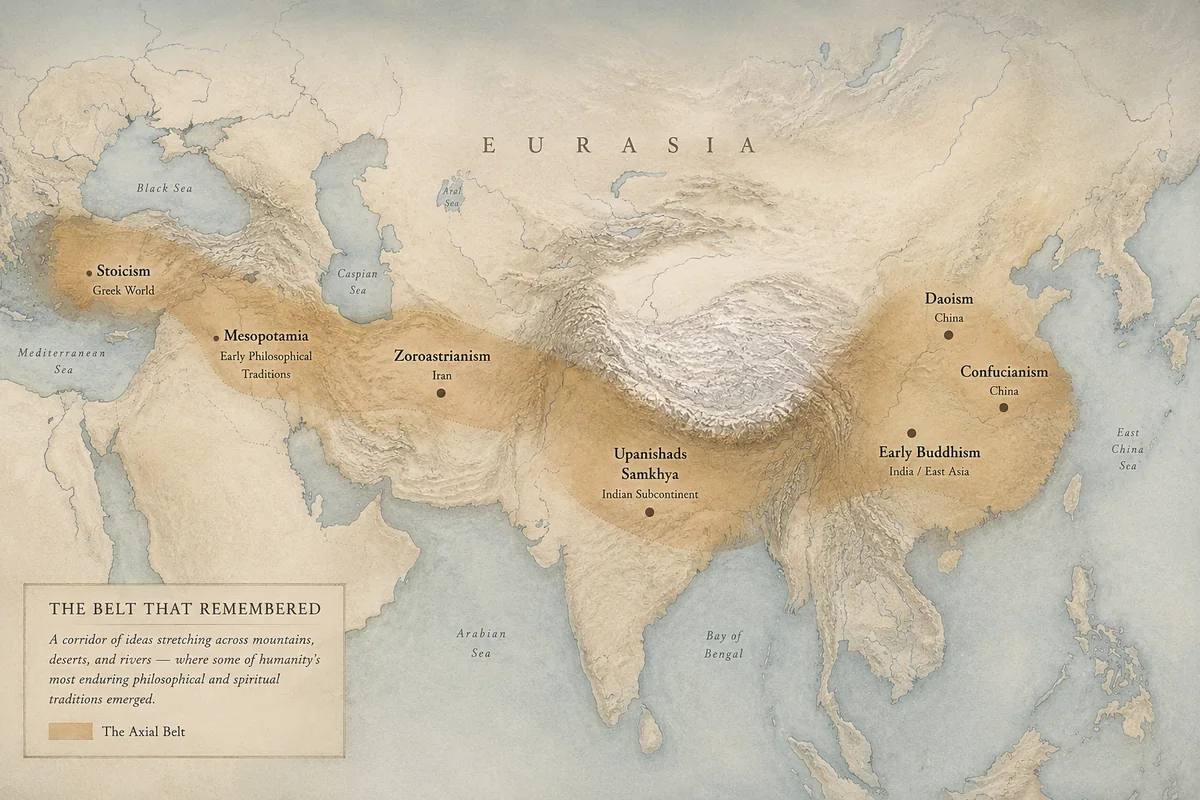
Long before ideas could travel quickly, remarkably similar ways of understanding reality appeared across the same broad belt of Eurasia. Coincidence is one explanation. It may not be the only one.
The Contingent Machine
Modern physics didn't emerge from pure curiosity. It emerged from war, industry, and the need to move things faster. That origin shapes everything we can — and cannot — ask.
Permissible Questions
Science has never developed in an ethical vacuum. What if the questions a civilization is permitted to ask determine the physics it eventually discovers?

Alternative
What if the most advanced civilization in Earth's history left almost nothing behind — not because it failed, but because it succeeded?